
Product guidance
Beyond SMS: Evaluating Messaging Channels for Verification
Explore a messaging channel strategy for identity verification using synchronous Telegram registration checks to support data hygiene and operational workflows.
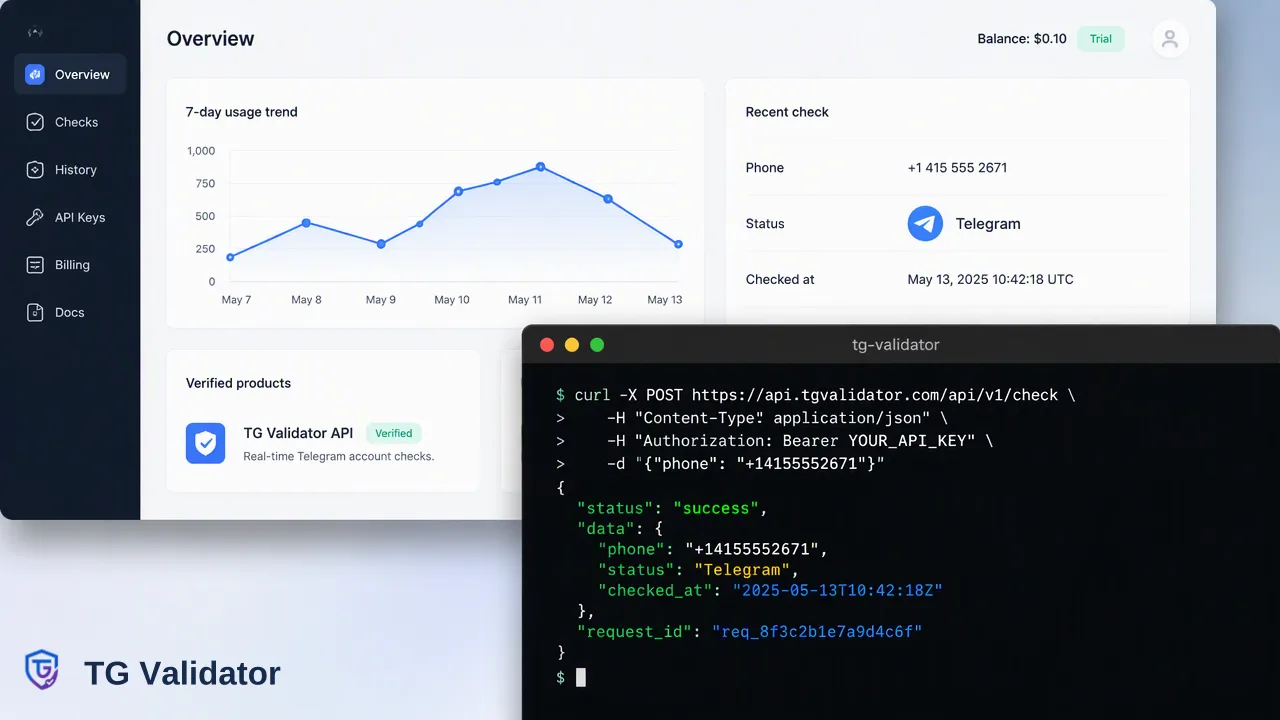
Explore how integrating synchronous Telegram registration checks supports data hygiene and informs operational workflows without relying on complex polling mechanisms.
A messaging channel strategy for identity verification relies on accurate account-presence signals to support data hygiene and operational workflows. Integrating Telegram registration checks provides a synchronous signal that helps organizations refine their contact lists. By using a same-response API model, developers can submit phone numbers in E.164 format and receive immediate registration status updates. This approach informs internal review processes and supports automated routing within existing backend systems without relying on complex polling mechanisms.
The Role of Messaging Channel Verification
Evaluating a messaging channel strategy for identity verification requires understanding the technical capabilities of registration-check tools. In modern communication workflows, verifying account presence on specific platforms like Telegram serves as a valuable signal for operational teams. Rather than assuming a phone number is associated with a specific messaging app, organizations can use registration checks to confirm whether an account exists at the time of the request. This account-presence signal helps teams review contact lists and supports lead list cleanup before campaign uploads. By filtering out numbers that are not registered on Telegram, operations teams can route records more effectively. Instead, it acts as one input alongside other checks to inform internal decisions and support data hygiene.
Synchronous vs. Asynchronous Verification
When implementing a messaging channel strategy for identity verification, the choice between synchronous and asynchronous processing impacts backend architecture. TG Validator provides a synchronous verification model, meaning one request returns one result in the same HTTP response. This synchronous approach offers distinct technical advantages for developer operations. It bypasses the requirement to build and maintain complex polling logic or handle asynchronous callbacks. When a system requests a Telegram registration check, the backend waits for the immediate response, allowing for straightforward integration into existing routing or filtering workflows. This same-response workflow supports immediate decision-making in backend systems, giving teams context for how to process a specific phone number without introducing unnecessary delay into the data pipeline.
Implementing Telegram Registration Checks
Integrating TG Validator into a verification workflow requires following a specific public API contract. The platform is positioned as a single, focused Telegram-verification product, and all requests must adhere to the documented input requirements.
First, all submitted phone numbers must be formatted according to the E.164 standard. The documented request contract uses a standard POST /api/v1/check endpoint. Developers must include an X-API-Key header and a Content-Type: application/json header. The JSON body requires two fields: "service_type": "tg" and the "identifier" containing the E.164 phone number.
The public API documentation describes a code, message, and data response envelope for these checks. Every check response carries an ID, the identifier, a transaction ID, status, service type, and the charged amount in micros. For Telegram checks, the public check contract states that the service returns the registration status specifically in the data.registered field. There are no avatar or business fields returned by this product; it provides a focused account-presence signal.
Managing Workflows with the Developer Dashboard
Beyond the API integration, managing a messaging channel strategy for identity verification requires visibility into usage and account metrics. The TG Validator developer dashboard supports operational oversight by providing tools to manage API keys and monitor account balances. Operations teams can use the dashboard to review check history and generate usage reports. The interface displays recent checks, balance spend, and seven-day trends, which helps administrators track API consumption over time. New accounts can also contact support to claim a $0.10 trial balance for Telegram registration checks, allowing developers to test the dashboard and API workflow before scaling their integration.
Operational Best Practices and Billing
Designing safe client-side handling is a critical component of any API integration. The public API documentation describes request-rate and concurrency limits that developers must account for. Systems should be designed to handle error codes gracefully, including those for unsupported service types, invalid JSON bodies, invalid phone numbers, missing or invalid API keys, insufficient balances, rate limits exceeded, all concurrency slots occupied, and validation service maintenance. Rate and concurrency limit rejections are not charged and create no check result. Billing for TG Validator is structured on a pay-per-check basis. To support cost-effective operations, failed or undetermined checks are refunded automatically. Finally, operational best practices require a clear understanding of the signal's boundaries. A Telegram registration check is an account-presence signal at the time of the check. Organizations should use this signal to inform review and support segmentation, rather than relying on it as a deterministic solution for compliance or fraud prevention.
FAQ
What does a Telegram registration check actually verify?
A Telegram registration check verifies account presence at the time of the request. It returns a registered status indicating whether the submitted E.164 phone number is associated with a Telegram account.
How does the synchronous API model improve workflow efficiency?
The synchronous API model returns the registration status in the same HTTP response as the initial request. This removes the need for developers to build complex polling mechanisms or manage asynchronous callbacks, supporting immediate routing and filtering in backend systems.
What happens if a check fails or returns an undetermined result?
TG Validator operates on a pay-per-check billing model. If a Telegram registration check fails or returns an undetermined result, the cost of the check is refunded automatically to the account balance.
How should phone numbers be formatted for the API?
All phone numbers submitted to the TG Validator API must be formatted according to the E.164 international numbering plan standard to ensure consistent processing.