
Product guidance
Understanding Phone Checker Signal Categories: Interpreting Telegram Registration Signals
Learn how to interpret phone checker signal categories, focusing on Telegram registration status, synchronous API workflows, and account-presence data.
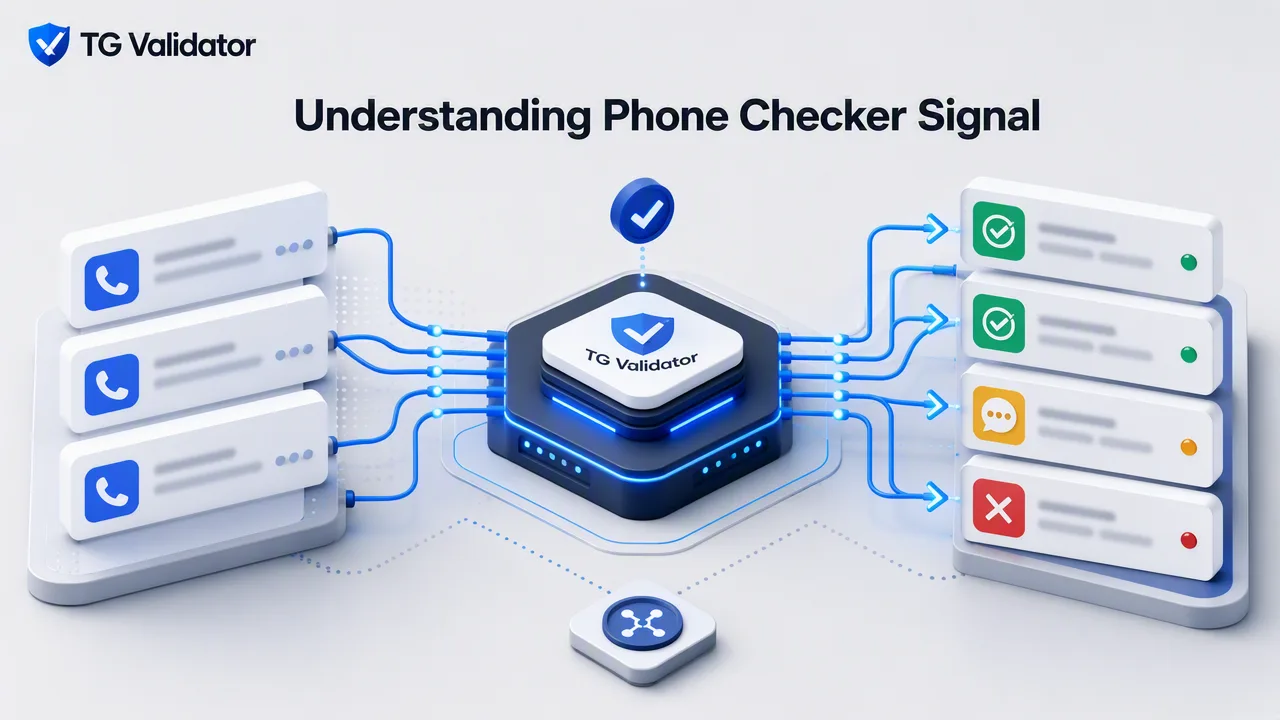
A technical guide to understanding phone checker signal categories, detailing how TG Validator provides synchronous Telegram registration signals for decision support without conflating account presence with identity or reachability.
A platform registration signal indicates whether a phone number is currently associated with an account on a specific service at the time of the check. Within phone checker signal categories, this serves strictly as an account-presence signal for decision support. TG Validator provides this specific signal for Telegram through a synchronous API, helping teams route records and inform review workflows based on documented registration status.
Defining Platform Registration Signals
When evaluating phone checker signal categories, it is critical to distinguish between an account-presence signal and broader identity verification. A registration signal confirms only that a submitted E.164 number is associated with a Telegram account at the exact moment of the check. TG Validator is a single-platform checker focused exclusively on Telegram registration status.
Synchronous vs. Asynchronous Verification
Verification workflows generally fall into synchronous or asynchronous models. TG Validator provides synchronous single checks and synchronous API batches. Use one request with one identifier for a single check, or submit up to 100 identifiers to /api/v1/batch-check; both return completed results in the initiating HTTP response. Neither flow creates an asynchronous job or requires webhooks or polling.
Integrating Registration Checks into Your Workflow
Integrating the TG Validator API requires formatting the input and handling the specific response envelope. Numbers must be submitted in E.164 format. The documented request contract uses a POST /api/v1/check endpoint, requiring an X-API-Key header and a JSON body containing service_type=tg and the identifier.
For a completed Telegram check, public data contains only service_type, identifier, and registered; internal record, transaction, status, and billing fields are not returned.
Managing API Reliability and Limits
Safe client-side handling requires accounting for documented API usage controls. The TG Validator API applies a per-account concurrency limit, and the API documentation is the reference for the value currently in force. Concurrency rejections and timeouts are not charged and create no check result. Review balance and check history in the dashboard; see the pricing page and API documentation for current billing rules.
FAQ
Does a registered status mean the user is active?
No. A registered result reports Telegram registration status at the time of the check.
How does the synchronous check model affect my integration?
TG Validator uses a synchronous request-response model where one request returns one result in the same HTTP response. This same-response workflow means you receive the registration status immediately without needing to build polling or webhook infrastructure.