
Product guidance
Carrier and Line-Type Data: The Complete Guide
Understand carrier and line-type data, mobile portability, and platform reachability signals to improve routing and message delivery workflows.
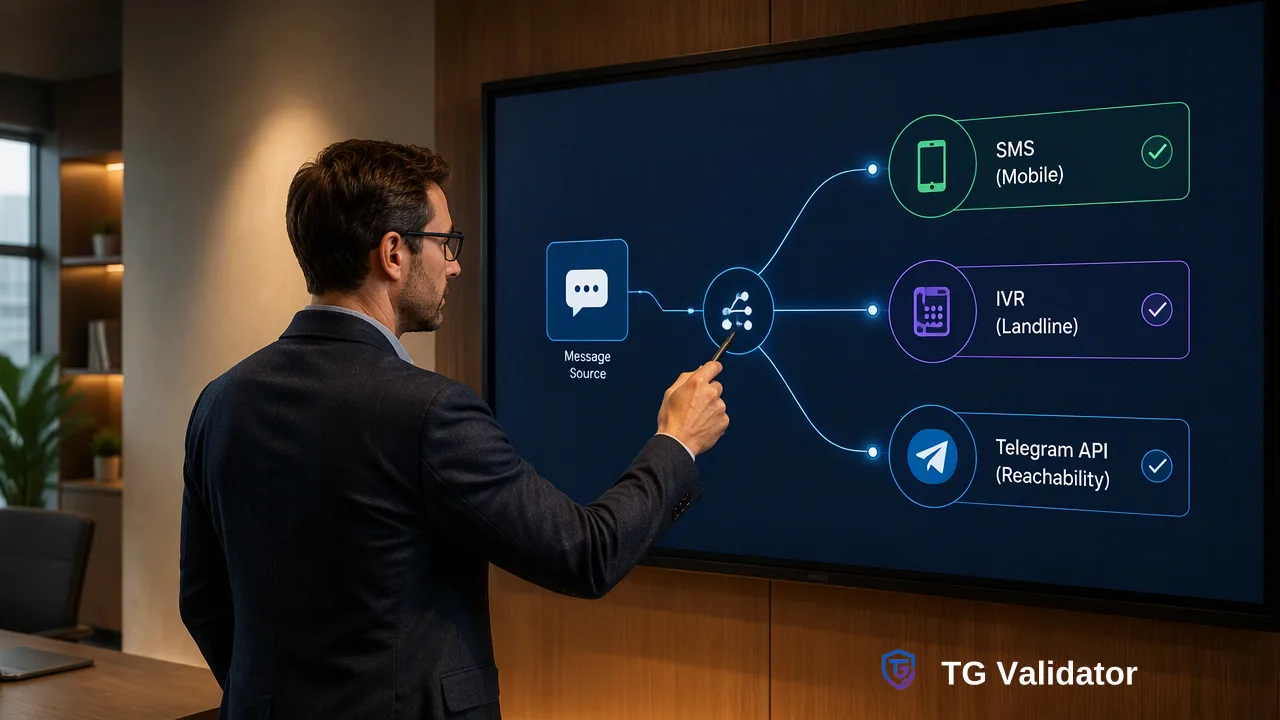
A technical guide explaining carrier records, line classifications, mobile number portability, and how platform-specific reachability signals inform communication routing.
Carrier and line-type data classify phone numbers by telecommunications provider and network category, such as mobile, landline, or VoIP. These attributes help organizations route communications between voice, SMS, and platform-specific channels, minimize transmission errors, and manage operational costs. However, carrier records reflect only network-level provisioning. When workflows require messaging across dedicated platforms, integrating a platform-specific reachability check provides verification of account presence at the time of the query without asserting identity, ownership, consent, or user reply.
Foundations of Carrier and Line-Type Classifications
Telecommunications routing depends on understanding the underlying infrastructure assigned to each phone number. Carrier data identifies the network operator responsible for terminating calls or SMS packets for a specific number. This operator may be an incumbent local exchange carrier (ILEC), a competitive local exchange carrier (CLEC), a wireless mobile network operator (MNO), or a mobile virtual network operator (MVNO). Line-type data describes the service classification and technical capabilities of the circuit or subscription. The primary line classifications include:
- Mobile (Wireless): Assigned to cellular devices serviced by an MNO or MVNO. These numbers support bidirectional voice and short message service (SMS), as well as multimedia messaging service (MMS). - Landline (Wireline): Fixed physical lines connected to traditional public switched telephone network (PSTN) switches. Landlines support standard voice calls but cannot natively receive standard cellular SMS unless connected to specialized third-party text-to-landline transcription gateways. - Voice over IP (VoIP): Virtual numbers hosted in cloud environments or private branch exchanges (PBX). VoIP numbers transmit voice packets over the internet using session initiation protocol (SIP). While many VoIP providers support SMS through web APIs, delivery characteristics and fraud risk profiles differ significantly from traditional cellular mobile lines. - Toll-Free and Special Service: Non-geographic numbers used primarily for inbound customer service. These lines often route directly to distributed contact centers and may support inbound SMS only if explicitly enabled with a messaging aggregator. Evaluating both carrier identity and line classification allows communication platforms to determine whether a number has the fundamental technical capability to receive voice calls, SMS text, or both.
The Mechanics and Operational Impact of Mobile Number Portability
In traditional telephony, telephone numbers were allocated in geographic blocks through numbering plans such as the North American Numbering Plan (NANP) or international national numbering plans. A number's country code, national destination code, and exchange prefix uniquely identified both the geographic location and the operating carrier. The advent of mobile number portability (MNP) and local number portability (LNP) severed the permanent connection between phone number prefixes and specific telecommunications carriers. Subscribers can migrate their existing phone number to a different mobile carrier, port a wireline landline to a mobile phone, or transition a cellular number to a cloud-based VoIP service. This continuous mobility introduces operational challenges for communication systems relying on static databases:
| Attribute | Static Prefix Tables | Real-Time Carrier Lookups |
|---|---|---|
| Accuracy Basis | Original number allocation | Current network routing registry (e.g., LERG, NPAC) |
| Portability Awareness | Fails to detect carrier changes | Detects transferred carriers and line-type transitions |
| Routing Efficiency | High risk of failed deliveries and misrouted packets | Directs traffic directly to the terminating carrier |
| Cost Control | Incurs transit penalties for misrouted traffic | Aligns interconnect fees with the actual serving carrier |
| When systems attempt to send SMS messages based on historical prefix data, messages sent to numbers that have ported from mobile to landline or non-SMS-enabled VoIP lines result in silent drop-offs, carrier bouncebacks, and wasted spend. |
Routing Strategy: Aligning Communication Channels with Line Types
Optimizing notification and verification workflows requires routing strategies that adapt to the detected line type. Instead of attempting a single delivery method across an entire contact list, engineering teams implement decision logic based on line attributes. ### Handling Landline Connections When line-type data identifies a number as fixed wireline, sending SMS messages is generally ineffective. Automated routing logic should either initiate an interactive voice response (IVR) phone call or prompt the user through an alternative channel, such as email or an in-app prompt. This avoids unnecessary SMS gateway charges and reduces delivery latency for urgent notifications. ### Managing VoIP Configurations VoIP numbers present unique routing considerations. Because virtual numbers can be provisioned and discarded rapidly through programmatic interfaces, many security and risk evaluation workflows treat non-fixed VoIP lines differently from postpaid mobile lines. For standard transaction updates, VoIP SMS routing is viable if the underlying provider supports it. For high-assurance verification, teams often supplement line-type queries with secondary verification channels. ### Directing Mobile Traffic Mobile lines represent the primary target for SMS messaging. Once carrier data confirms that a number is currently hosted on an active mobile network operator, the messaging gateway can format and dispatch standard SMS or MMS payloads through the appropriate regional aggregator.
Distinguishing Network Infrastructure from Platform-Specific Reachability
A common architectural misconception is treating carrier and line-type data as a comprehensive indicator of digital reachability. Carrier lookups confirm network-level provisioning on the telecommunications grid, but modern communication increasingly takes place on dedicated over-the-top (OTT) messaging platforms. A number may be an active, verified mobile number on a major cellular network yet never interact with specific digital applications. Conversely, users frequently utilize messaging applications over data connections or local Wi-Fi while their standard cellular SMS remains disabled or unmonitored. Platform-specific reachability checks operate at an entirely different layer of the communication stack:
- Telecom Carrier Checks: Confirm the serving carrier, operating country, and line type (mobile, landline, VoIP) on the public switched network. - Platform-Specific Checks: Provide an account-presence signal indicating whether the phone number is registered on a specific communication network at the time of the check. For instance, TG Validator provides a Telegram registration-checking platform accessible via a web dashboard and a synchronous REST API. The check inspects whether a submitted E.164 phone number has an platform account-presence signals presence on Telegram. When used alongside carrier data, this signal helps organizations determine whether Telegram is a technically viable messaging channel for that specific identifier.
Architectural Patterns for Multi-Tiered Routing Workflows
To achieve resilient and cost-effective communication flows, organizations can deploy a multi-tiered validation and routing pipeline. This architecture processes raw phone numbers through systematic stages before dispatching communications. 1. Standardization and Normalization: Inbound phone numbers are parsed and formatted into international E.164 standard format (e.g., +12025550143). This step standardizes country codes, area codes, and subscriber numbers, preventing parsing failures across downstream interfaces. 2. Carrier and Line-Type Inspection: The pipeline checks carrier and line-type attributes to separate mobile numbers from landline, toll-free, and VoIP lines. Landlines are routed immediately to voice channels, while invalid formats are filtered out. 3. Platform Reachability Query: For mobile and supported VoIP numbers intended for multi-channel engagement, the system evaluates platform presence. For example, querying TG Validator via its synchronous check verifies if the identifier is registered on Telegram. If registered, the platform can be selected as a supported routing path. 4. Dispatch and Fallback Logic: The notification service initiates dispatch using the preferred, cost-effective channel. If delivery encounters a transient failure or channel timeout, the workflow executes automated fallback to standard mobile SMS or voice calls.
FAQ
What distinguishes carrier data from line-type classifications?
Carrier data identifies the telecommunications operator currently assigned to route traffic for a phone number, such as a major mobile network operator or competitive local exchange carrier. Line-type data specifies the functional category of the connection, such as mobile, traditional landline, or VoIP, indicating the communication modalities the number can receive at the infrastructure level.
How does mobile number portability affect communication routing?
Mobile number portability separates a phone number from its originally assigned routing prefix, allowing subscribers to transfer numbers between mobile operators or across line types.
Can line-type data confirm whether a mobile message will be delivered?
Line-type data confirms that a number is provisioned as a mobile line capable of receiving SMS via standard cellular protocols, but it does not confirm device status, power state, network connectivity, inbox capacity, or recipient attention. It functions as a capability check rather than a message delivery confirmation.
What role do platform-specific reachability signals serve alongside carrier data?
Carrier data determines standard telecom routing capabilities such as SMS and voice delivery. Platform-specific reachability signals, such as checking whether a phone number is registered on Telegram, provide an account-presence signal at check time.
Learn More
Choose the product information that fits the next step in your workflow.