
Product guidance
Best Practices for Segmenting Contact Lists with Telegram Registration Data
Learn contact list segmentation best practices using TG Validator's synchronous API to filter E.164 numbers by Telegram account presence.
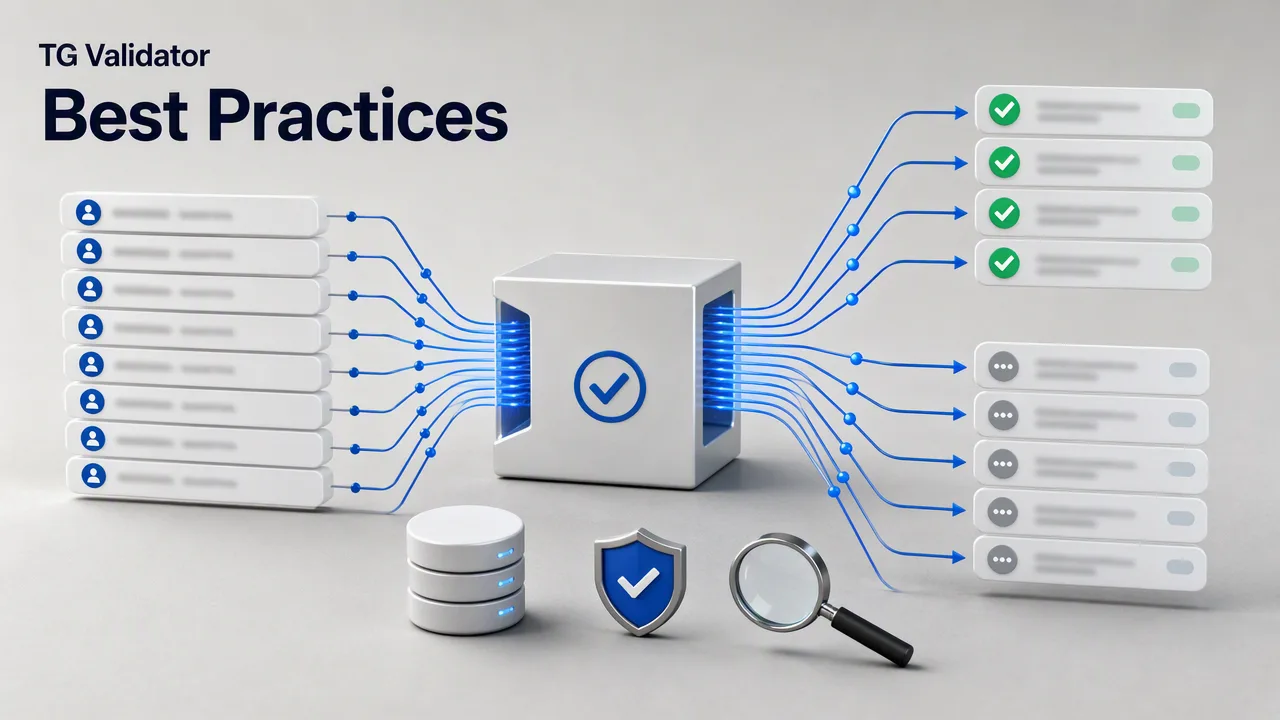
A technical guide on using TG Validator's synchronous API to segment contact lists based on Telegram account presence, including input formatting, error handling, and result interpretation.
Segmenting a contact list using TG Validator involves submitting phone numbers in E.164 format to the synchronous API. By utilizing the registered boolean field returned in the data envelope, you can categorize contacts based on their presence on Telegram. This account-presence signal informs your segmentation strategy, helping teams route outreach or support workflows toward records with a platform account presence. Implementing these contact list segmentation best practices helps operations separate registered numbers from unregistered ones before initiating communication.
Standardizing Inputs for Reliable Segmentation
A foundational step in contact list segmentation best practices is standardizing the data before it reaches the verification endpoint. TG Validator requires all submitted phone numbers to be formatted according to the E.164 international numbering plan. This format includes a '+' prefix followed by the country code and the subscriber number, providing a globally consistent identifier.
When integrating the check into your workflow, the documented request contract uses the POST /api/v1/check endpoint. Requests must include the X-API-Key and Content-Type: application/json headers, along with a JSON body containing the target E.164 number and the service_type set to tg. Adhering to this exact input structure supports the validation service in processing the record without triggering invalid phone number or invalid JSON body error codes. Consistent formatting helps teams maintain a clean data pipeline, which is critical when segmenting large CRM databases or support contact lists.
Leveraging Synchronous Registration Signals
TG Validator operates as a synchronous check, meaning one request returns one result in the same HTTP response. This same-response workflow is highly efficient for sequential list processing, as it eliminates the need for complex asynchronous polling or webhook management.
The documented check contract specifies that the Telegram service returns the registration status within the data.registered field. Because service_type=tg returns only this boolean field—without extraneous avatar or business profile data—the response is lightweight and easy to parse. Teams can use this binary signal to immediately branch their contact lists. For example, records returning a true status can be routed to a dedicated Telegram support or outreach queue, while unregistered numbers can be directed to alternative channels like SMS or email. This clear division is a core component of effective contact list segmentation best practices.
Managing API Throughput and Error Handling
When processing contact lists, managing API throughput is essential to maintain service continuity. The public API documentation for TG Validator outlines the concurrency limit on simultaneous checks per user. Designing your client-side application to respect these limits helps avoid unnecessary request rejections. Failed, timed-out, and undetermined checks do not retain the charge. See the pricing page for current billing details.
Interpreting Registration Status Correctly
A critical aspect of contact list segmentation best practices is understanding the exact scope of the data you are using. A registered result from TG Validator reports the Telegram registration status at the specific time of the check. It serves strictly as an account-presence signal.
It is important to recognize the boundaries of this signal. It does not indicate recipient preference, online status, message history, or whether the number is currently reachable for messaging. Teams should use this signal to inform internal decisions and support routing logic, rather than treating it as proof of message delivery or user engagement. By scoping the interpretation correctly, organizations can build compliant and accurate segmentation workflows.
Monitoring Workflows via the Developer Dashboard
Effective segmentation requires ongoing oversight of the verification process. The TG Validator developer dashboard supports this by providing comprehensive tools for managing API keys and tracking account balance. Operators can review check history, generate usage reports, and monitor recent checks to audit how contact lists are being processed. The dashboard also displays balance spend and account activity, giving technical teams visibility into API consumption patterns. For new integrations, teams can contact support to receive 100 free checks, then try the service specifically for Telegram registration checks, helping them test their segmentation logic and API handling before scaling up to larger lists.
FAQ
How should I format phone numbers for the API?
All phone numbers must be submitted in the E.164 international format. This requires a '+' prefix followed by the country code and the subscriber number.
What happens if too many of my checks run at once?
TG Validator enforces a documented limit on concurrent checks. If you exceed these limits, the API will return a documented error code. These rejected requests are not charged and do not generate a check result.
How is billing handled for failed checks?
Failed, timed-out, and undetermined checks do not retain the charge. See the pricing page for current billing details.