
Product guidance
Optimizing CRM Data Hygiene with Telegram Registration Verification
Learn how to build a CRM contact verification workflow using TG Validator's synchronous API to check Telegram registration status and improve segmentation.
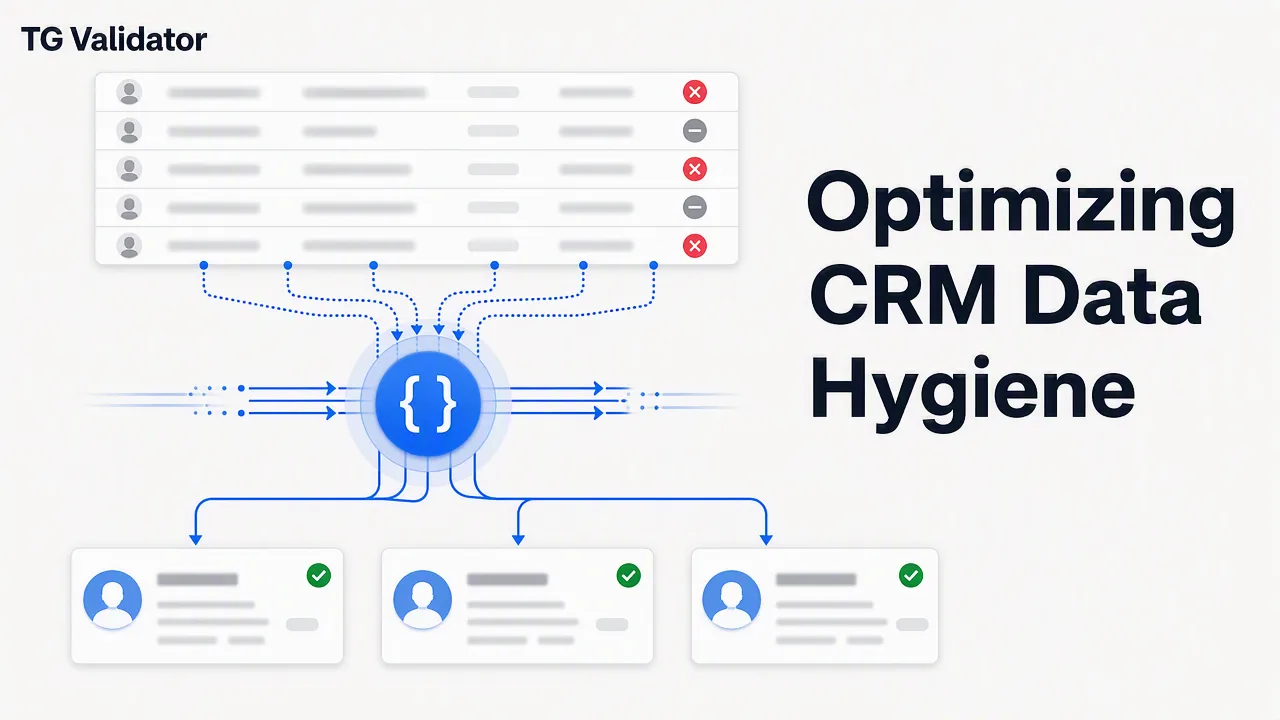
A technical workflow guide for integrating TG Validator to improve CRM segmentation through verified Telegram registration signals.
A CRM contact verification workflow using TG Validator helps teams maintain cleaner databases by checking if a phone number is registered on Telegram. By submitting numbers in the E.164 format to the synchronous REST API, businesses receive an account-presence signal in the same HTTP response. This documented registration status informs internal decisions and supports more precise contact segmentation based on platform presence at the time of the check.
The Role of Registration Verification in CRM Hygiene
Maintaining accurate contact records requires understanding which platforms are associated with a given phone number. Integrating a Telegram registration check into a CRM contact verification workflow provides a specific account-presence signal that helps teams segment their audiences more effectively. When a number is queried, the resulting registered status indicates whether that phone number is associated with a Telegram account at the exact time of the check. By integrating this check during the initial contact entry or during periodic database audits, organizations can maintain a cleaner baseline of platform-specific data.
It is important to scope this signal correctly within internal systems. This signal serves as one input alongside other checks, giving operators the context needed to route records appropriately, apply platform-specific tags, and clean up outdated CRM entries.
Implementing the Synchronous Verification Workflow
TG Validator provides synchronous single and small-batch APIs. Use the single endpoint for one identifier or the synchronous multi endpoint for up to 100 identifiers; each completed request returns in the same HTTP response, without polling or webhook callbacks. This simplifies CRM integration because the system can immediately tag or route records from the returned values.
To initiate a check, the client must send a POST request to the /api/v1/check endpoint. The documented request contract requires an X-API-Key header for authentication and a Content-Type: application/json header. The JSON body must specify the target, formatted as {"service_type": "tg", "identifier": "<E.164 number>"}. The phone number must strictly adhere to the E.164 international standard.
For a completed Telegram check, the returned data contains only service_type, identifier, and registered; internal record, transaction, status, and billing fields are not returned.
Managing API Limits and Reliability
A robust CRM contact verification workflow must account for API usage controls to maintain service continuity and avoid dropped requests. TG Validator enforces documented limits to manage load, including a cap on how many checks one user may run simultaneously; the API documentation carries the current values. Developers should design client-side handling to respect these boundaries. If all concurrency slots are occupied, or if a check does not finish within its time budget, the API returns specific error codes. Rejections caused by hitting these limits do not create a check result and are not charged. Failed, timed-out, and undetermined checks do not retain the charge. See the pricing page for current billing details.
Monitoring and Dashboard Operations
Beyond the API integration, TG Validator includes a developer dashboard that supports ongoing administrative and operational tasks. This interface helps teams monitor the health and financial status of their CRM contact verification workflow without needing to query the API for account metadata. Administrators use the dashboard to manage API keys and monitor their available balance. For reporting and auditing, the interface provides access to check history, recent checks, and detailed usage reports. Teams can also review their balance spend and analyze account activity to understand query volume over time and adjust their CRM synchronization schedules accordingly. For new accounts evaluating the service, support can be contacted to claim 100 free checks specifically for Telegram registration checks.
FAQ
What does the 'registered' signal indicate?
The registered result reports Telegram registration status at the exact time of the check.
How should I format phone numbers for the API?
All phone numbers submitted to the TG Validator API must be formatted in the international E.164 standard. The API will return an invalid phone number error code if the input does not match this format.
What happens if a check fails or is rejected for concurrency?
Failed, timed-out, and undetermined checks do not retain the charge. See the pricing page for current billing details.
Is the TG Validator API asynchronous?
No, TG Validator operates as a synchronous API. A single request for an E.164 number returns one result in the same HTTP response, rather than using webhooks, polling, or asynchronous batch processing.