
Product guidance
Format Validation vs Live Verification: What You Actually Need
Compare format validation vs live phone verification to understand when to check E.164 structure and when to confirm Telegram account presence.
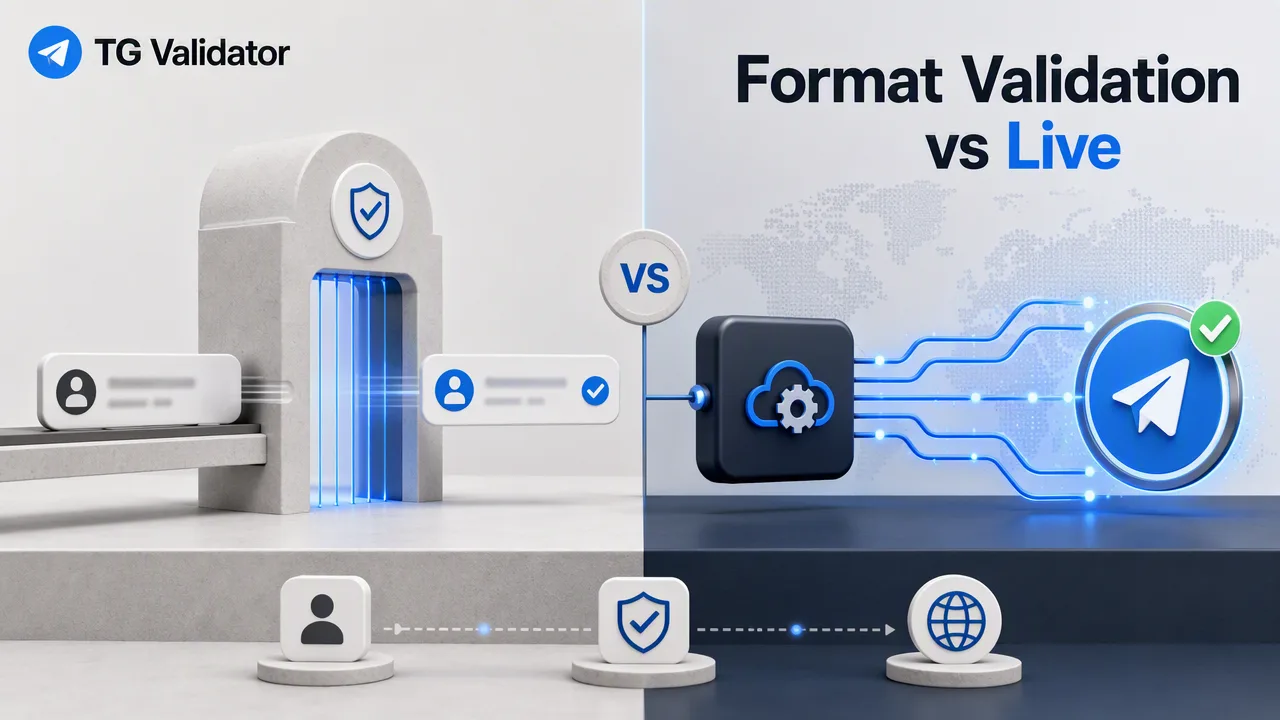
A technical comparison of structural format validation versus live platform-presence checks, detailing when to use each method for Telegram registration workflows.
Format validation ensures a submitted phone number follows the E.164 standard, filtering out basic structural errors without querying external databases. However, it cannot confirm if a number is associated with a specific platform. For Telegram-specific workflows, live phone verification is required to confirm account presence at the time of the request. Using a synchronous same-response request flow, a live check provides a necessary Telegram registration status signal to inform downstream decision-making.
Understanding Format Validation
Checking a phone number for structural compliance is the first step in data hygiene. Format validation confirms that a submitted string adheres to a specific standard, such as E.164, without querying external databases. This local, cost-effective process helps teams filter out malformed data and basic input errors before any external requests are made. While structural validation is necessary for standardizing records, it only confirms that a number is formatted correctly, not whether it is currently registered on a specific messaging platform.
The Role of Live Platform Verification
When a workflow depends on knowing if a number is registered on Telegram, structural checks are insufficient. Live platform verification queries the platform to confirm registration status. TG Validator provides a synchronous same-response request flow for this purpose, operating as a single, focused Telegram-verification product. A "registered" result indicates an account-presence signal at the time of the check.
When to Use Which Approach
Selecting the right method depends on the specific requirements of the data workflow.
- Format Validation: Use this approach for initial data entry and cleaning. It supports standardizing records to the required E.164 format and rejecting obvious structural errors before they enter a database.
- Live Verification: Use this approach when your workflow requires a Telegram registration status. If downstream routing or review depends on knowing whether a submitted E.164 number is associated with a Telegram account, a live check provides the necessary account-presence signal.
Integrating TG Validator
For technical teams implementing live checks, TG Validator offers a straightforward API and dashboard workflow.
API Workflow
The service uses a synchronous POST /api/v1/check request. Developers submit an E.164 phone number along with the X-API-Key header and service_type=tg. The API returns a documented code, message, and data response envelope, with the Telegram registration status located in the data.registered field. To support stable integration, the API enforces a concurrency limit per user, with the current value published in the API documentation. Concurrency rejections and timeouts are not charged and create no check result.
Dashboard Workflow
Failed, timed-out, and undetermined checks do not retain the charge. See the pricing page for current billing details.
FAQ
Can I use TG Validator to check for other platforms?
TG Validator is positioned as a single, focused Telegram-verification product rather than a multi-platform checker. It specifically checks for Telegram registration status.
What happens if a check fails or is rejected before it runs?
Failed, timed-out, and undetermined checks do not retain the charge. See the pricing page for current billing details.