
Product guidance
Optimizing International Phone Number Validation for Cross-Border Commerce
Learn how international phone number validation and platform-specific reachability checks support cross-border commerce and operational workflows.
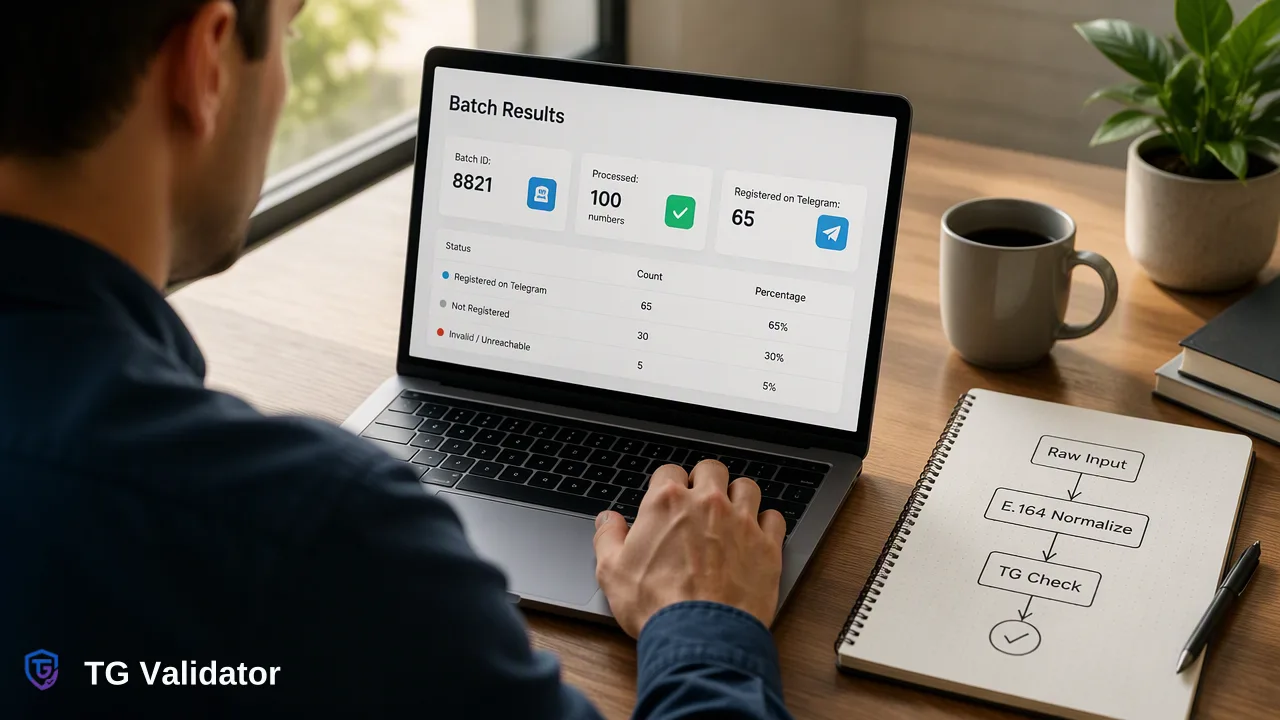
Explore how combining E.164 format standardization with synchronous platform-specific reachability checks helps organizations manage international contact data and streamline cross-border communication workflows.
For cross-border commerce, international phone number validation requires a two-tiered approach: standardizing contact data to the E.164 global format and verifying platform-specific reachability. While format normalization ensures technical consistency across diverse regional numbering plans, a platform registration check confirms whether that identifier is currently active on a specific communication network, such as Telegram. By integrating synchronous reachability signals into their operations, organizations can route records effectively, support contact segmentation, and inform internal review processes. This dual process helps teams confirm that international contact identifiers are technically valid and reachable, reducing operational friction in global outreach workflows.
The Challenge of International Numbering in Global Commerce
Managing international commerce means handling contact data from dozens of different countries, each with its own numbering plan, dialing codes, and length requirements. When users span many regions, inconsistent data entry creates downstream failures in communication and routing. International phone number validation begins with structural normalization. The foundational step is converting all local inputs into the E.164 format. This international standard ensures global uniqueness by combining the country code, area code, and subscriber number into a single string, typically prefixed with a plus sign. Without E.164 normalization, systems cannot reliably parse or process cross-border contacts. Standardizing to this format resolves structural inconsistencies, allowing databases to store uniform identifiers regardless of the customer's origin country. However, while structural correctness is a prerequisite for international operations, it only confirms that a number follows the correct mathematical pattern for its region. It does not provide insight into the current status of the line or its presence on modern communication platforms.
Beyond Format: The Role of Platform-Specific Reachability
Format validation ensures technical correctness, but cross-border commerce workflows often require deeper context to optimize outreach. This is where platform-specific reachability checks become necessary. Instead of relying solely on structural patterns, organizations use targeted queries to determine if a standardized E.164 number is currently registered on a specific network. For teams utilizing TG Validator, this involves checking the identifier against Telegram. By confirming that a contact is present on the Telegram platform, businesses gain a concrete data point that supports contact segmentation and informs communication strategies.
Integrating Reachability Checks into Operational Workflows
Integrating platform-specific reachability checks into operational workflows requires a system capable of processing requests without introducing latency into the customer journey or internal data pipelines. TG Validator provides a synchronous REST API designed for this purpose. Teams can implement these checks directly into their data ingestion or review stages. The product supports a same-response synchronous request flow, meaning there is no task-submission, polling, callback, or download step required to retrieve the data. For individual record processing, the single-number endpoint accepts one E.164 identifier per request. When organizations need to process lists of international contacts, the synchronous batch endpoint accepts up to 100 identifiers in a single request. This batch endpoint returns the entire set of results in the same HTTP response or fails as a whole, allowing teams to efficiently validate small segments of cross-border data. By utilizing these synchronous endpoints, developers can build routing logic that immediately categorizes contacts based on their Telegram registration status, helping operators prioritize outreach and manage international lists with greater precision.
Structuring the Data: E.164 Input and Synchronous Responses
The technical implementation of international phone number validation relies on strict adherence to documented API contracts. To initiate a Telegram registration check, developers use the POST /api/v1/check endpoint. The request must include the X-API-Key header for authentication and a JSON body specifying the target. The payload requires two fields: service_type set to tg, and identifier containing the E.164 formatted phone number. The outer response envelope for a completed check consists of a code, message, and data object. Within the public data object, the API returns the service type, the identifier, and a registered boolean. This boolean is only provided for a completed, decided check. If a check cannot be determined, the API returns a non-zero business code rather than a completed result object. Developers must design client-side handling that respects documented per-user concurrency and timeout controls. Concurrency-limit rejections are returned before a check is created and do not generate a completed check result, ensuring that integration logic can gracefully handle high-volume cross-border validation tasks.
Dashboard and Developer Operations for Cross-Border Teams
Beyond API integration, managing international phone number validation requires visibility into usage and operational metrics. The TG Validator developer dashboard provides teams with the necessary tools to oversee their cross-border verification workflows. Administrators can manage API keys, monitor account balances, and review check history from a centralized interface. The dashboard supports detailed usage reporting, allowing organizations to track recent checks and analyze balance spend over time. By utilizing the 7-day trends feature, operations teams can identify patterns in international contact validation, helping them adjust their segmentation strategies or investigate anomalies in data ingestion. This operational visibility ensures that businesses can maintain efficient, uninterrupted validation processes as they scale their commerce activities across diverse global markets.
FAQ
Why is E.164 formatting important for international validation?
E.164 is an international standard that ensures global uniqueness for phone numbers by combining the country code, area code, and subscriber number. Submitting numbers in this format is a strict requirement for validation APIs, as it resolves regional dialing variations and provides a consistent, standardized input for processing cross-border contact data.
How does platform-specific reachability improve cross-border communication?
How do synchronous batch checks process international numbers?
Synchronous batch checks allow teams to submit up to 100 E.164 identifiers in a single API request. The system processes the entire batch and returns the results in the same HTTP response. This same-response workflow eliminates the need for asynchronous polling or callbacks, streamlining the validation of small contact segments.
What data is returned in a Telegram registration check?
A completed check returns an outer response envelope containing a code, message, and data object. The public data object includes the service type, the submitted E.164 identifier, and a boolean indicating registration status.