
Fixing 'Phone Number Must Be in E.164 Format' Errors
Fix missing country codes, plus signs and national prefixes before submitting a number for a Telegram registration check.
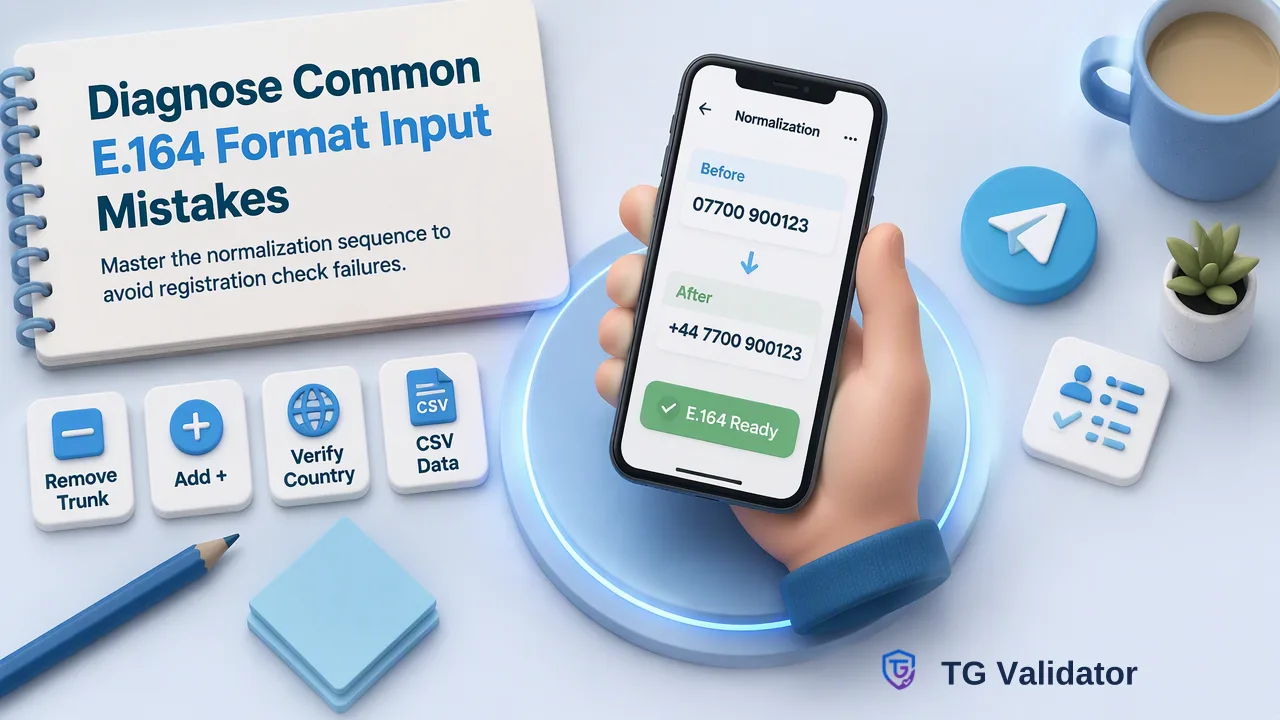
Fix missing country codes, plus signs and national prefixes before submitting a number for a Telegram registration check.
A 'phone number must be in E.164 format' error means the submitted value needs an international-format phone number before a Telegram registration check can use it. Start with the correct country code and national number, add the leading plus sign, and remove display punctuation and any national dialing prefix that does not belong in the international form. Validate the transformed value against the source record before resubmitting it; a syntactically neat but incorrect number is still the wrong input.
What the E.164 requirement is checking
E.164 is the international numbering plan published by the International Telecommunication Union. In everyday application input, its familiar presentation begins with a plus sign, followed by a country code and the national significant number. The plus sign represents international dialing context; spaces, brackets and hyphens may help a person read a phone number, but they are not part of the compact value a checking API expects.
A formatting error happens before a meaningful registration answer. It should not be recorded as “not registered on Telegram.” TG Validator's realtime single-number registration check requires the submitted phone number in E.164 form. Once the input is accepted, a decided result concerns Telegram account presence for that submitted number at check time. The format check itself says nothing about account presence, identity, ownership or contact permission.
Use the original source value and the known country together. Do not guess a country code from the first digits of an incomplete number or from the country in a contact's mailing address. A national number can be meaningful only with its numbering context. When the country is unknown, hold the record for data review instead of silently creating a plausible-looking international number.
Diagnose the most common input mistakes
Begin by inspecting the exact string sent to the check, not merely the way a spreadsheet displays it. A missing plus sign is common when a field was stored as a number. So are spaces, parentheses and hyphens copied from a human-readable contact card. Some sources retain a national trunk prefix that should be omitted after the country code is added. Other sources already include the country code, so prepending it again creates a duplicate.
| Symptom | Likely data issue | Review action |
|---|---|---|
| No leading plus sign | National or stripped international value | Confirm country, then construct international form |
| Brackets or separators | Human display format copied into API input | Remove presentation characters from the submitted value |
| Extra initial zero after country code | National dialing prefix retained | Apply the specific country's international dialing rule |
| Repeated country code | Code added to an already international number | Compare with the source and remove the duplicate |
| Unexpected number of digits | Lost digits, extension or wrong country | Recheck source record and country-specific plan |
The Twilio E.164 error guide illustrates a common service-side requirement for the same compact shape. It does not define TG Validator's registration result. For a country-specific transformation, consult authoritative numbering guidance; a generic “remove every zero” rule is unsafe because a zero may belong inside the national significant number.
Normalize in a controlled sequence
First preserve the raw value in a separate field. Second assign a trusted country or numbering region from the source record. Third strip only display characters such as spaces, hyphens and brackets; do not discard digits simply because they look unusual. Fourth decide whether the value already has a plus and country code. Fifth, if it is national format, apply the relevant national-to-international rule, including whether a trunk prefix must be removed. Finally, check that the output begins with one plus sign, contains the intended digits and has no extension embedded in the submitted value.
For example, a UK national-format number may have a leading 0 used in domestic dialing. In an international representation, the UK country code is +44 and that domestic trunk 0 is generally dropped. The transformation must be based on a verified UK number; it is not a universal rule for all countries. The ITU definition of a national trunk prefix explains why the national dial string and an international number can differ. Keep the source and transformed value side by side so a reviewer can catch accidental digit loss.
Do not use a regex match alone as the final quality gate. A regex can catch obvious punctuation or a missing plus sign, but it cannot determine whether the country is correct or whether a local numbering rule was applied properly. A country-aware parser can assist, yet the team's source data still needs review when country or ownership information is uncertain.
Check what the spreadsheet or CRM actually stores
Excel and similar tools can silently alter phone-like values when a column is treated as numeric. Microsoft recommends formatting cells as text before entry, because phone numbers are identifiers rather than quantities for arithmetic. A visually correct custom format may only change display and leave a different underlying value. If a leading digit was lost before the cell became text, changing the format afterward will not reconstruct it.
Before sending a batch, export a small sample and inspect the raw TXT or CSV in a plain-text viewer. Confirm the first and last rows, a few entries with national prefixes and a few international entries. Count the digits in the source and transformed values for those samples. If a row contains an extension, keep it in a separate CRM field; it is not the submitted phone number for a Telegram registration check.
If the source is a form, collect country and phone number in distinct, validated fields when practical. If it is an old list, mark uncertain rows for review rather than applying a broad conversion that could change thousands of numbers incorrectly. This is especially important when a list contains multiple countries.
Resubmit the correct workflow after fixing input
For a single record, use TG Validator's dashboard Single Check or its realtime REST registration check after normalization. The REST single check is the documented POST /api/v1/check path. A decided check returns the registration result in the same request session. An undecided check is a separate outcome with a non-zero business code; it should not be reclassified as a format error or as a negative registration result.
For a small set, the realtime batch route can check up to 100 numbers through the API, and the dashboard's Realtime Batch Check can accept up to 500 pasted numbers. A much larger prepared list follows the separate asynchronous bulk-file workflow, with TXT or CSV input, task monitoring and a result download. Review the current TG Validator API documentation before choosing a route or encoding request details. These workflows differ, but each benefits from the same source-preserving normalization process.
After a correction, log which record changed and why. If a previous check used the wrong number, do not edit that historical result as though it referred to the corrected number. Run a new check for the corrected value and retain a clear audit trail. The goal is a result about the intended number, not merely the disappearance of an input error.
FAQ
How can teams fix a missing plus sign in an E.164 error?
Confirm the source number and country, then construct the international value with one leading plus sign and the correct country code. Do not add a guessed code to an uncertain record.
Should teams remove every leading zero from phone numbers?
No. Apply the numbering rule of the specific country. A national trunk prefix may be omitted internationally, but other zeros can be meaningful digits.
What should happen to a record that still fails after normalization?
Keep the raw and transformed values, inspect the country and source data, and route the record for review. A format failure is not a Telegram registration result.
Learn More
Choose the product information that fits the next step in your workflow.