
Product guidance
Phone Verification Before Messaging Send: Telegram Checks
Integrate a synchronous Telegram registration check into your pipeline to verify phone numbers before messaging send, optimizing resources and workflows.
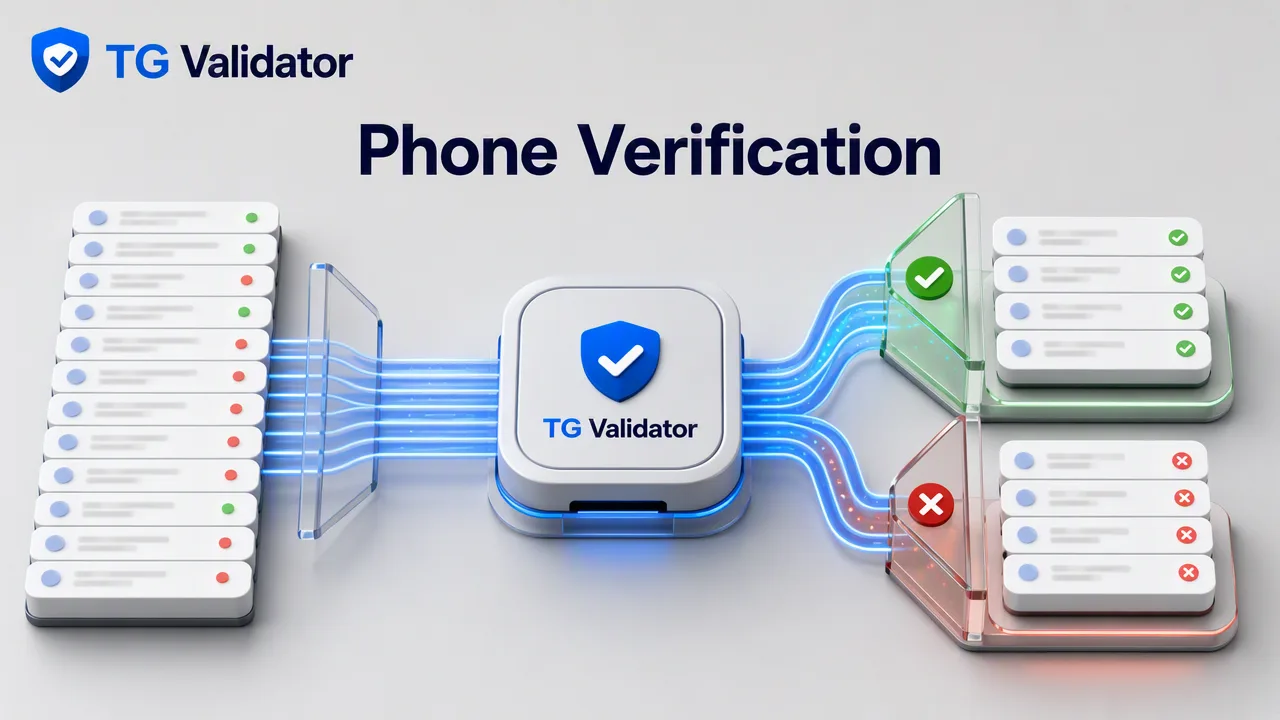
Learn how to integrate synchronous Telegram registration checks into your messaging pipeline to verify phone numbers and optimize resources before initiating a send.
Before initiating a messaging campaign, developers can integrate a synchronous registration check to verify if a phone number is associated with a Telegram account. By using the TG Validator API, systems receive a same-response registration signal. This allows the messaging pipeline to filter out invalid identifiers before committing resources, optimizing phone verification before messaging send and improving overall workflow efficiency.
The Role of Pre-Send Validation in Messaging
Sending notifications to unverified numbers consumes resources and complicates pipeline metrics. Integrating a pre-send validation step helps teams review contact lists and route records effectively. A Telegram registration check provides a clear account-presence signal at the time of the request. Because the check is synchronous, it allows for immediate decision-making within the messaging pipeline. This same-response workflow informs internal decisions on whether to proceed with a messaging send, so resources are directed toward numbers with an established Telegram presence.
Technical Workflow: Integrating TG Validator
TG Validator provides focused Telegram registration checks through synchronous single and small-batch APIs. Use POST /api/v1/check for one identifier or POST /api/v1/batch-check for up to 100 E.164 identifiers; both require an X-API-Key header and return in the initiating HTTP response.
To process successfully, all submitted phone numbers must be formatted according to the E.164 standard. The request payload must also specify the selected service using "service_type": "tg".
For a completed Telegram check, public data contains only service_type, identifier, and registered; internal record, transaction, status, and billing fields are not returned.
Managing API Performance and Reliability
Designing safe client-side handling requires accounting for documented API limits and error states. TG Validator applies a concurrency limit to each account, and the API documentation lists the value that applies today. Requests that exceed the published limit are rejected, create no check result, and are not charged. The API provides specific error codes to guide pipeline logic. Developers should handle error signals for unsupported service types, invalid JSON bodies, invalid phone numbers, missing or invalid API keys, insufficient balances, occupied concurrency slots, checks that did not finish within their time budget, and validation service maintenance. Review balance and check history in the dashboard; see the pricing page and API documentation for current billing rules.
Monitoring and Optimization via Dashboard
Operational oversight is managed through the TG Validator developer dashboard. The dashboard supports comprehensive balance management and API key administration, giving teams visibility into their verification workflows. Operators can access usage reports, check history, and recent checks to audit pipeline performance. The dashboard also displays balance spend and account activity, which helps teams monitor the efficiency of their pre-send validation process. For new integrations, developers can contact support to receive a $0.10 account credit, then try the service to test the Telegram registration checks before moving to production.
FAQ
How does the synchronous API check work in a messaging pipeline?
The product is synchronous, meaning one request returns one result in the same HTTP response. Systems submit an E.164 phone number via a POST /api/v1/check request and receive the registration status in the same response, allowing the pipeline to route records before a messaging send.
What happens if a request is rejected for concurrency?
TG Validator caps how many checks one account can have in flight at the same time; see the API documentation for the current value. If a request exceeds the limit, it is rejected with a specific error code, creates no check result, and is not charged.