
Scaling Telegram Presence Validation: A Technical Guide to Synchronous API Integration
Learn how to integrate the TG Validator synchronous API for high-volume Telegram presence validation, manage concurrency limits, and handle billing.
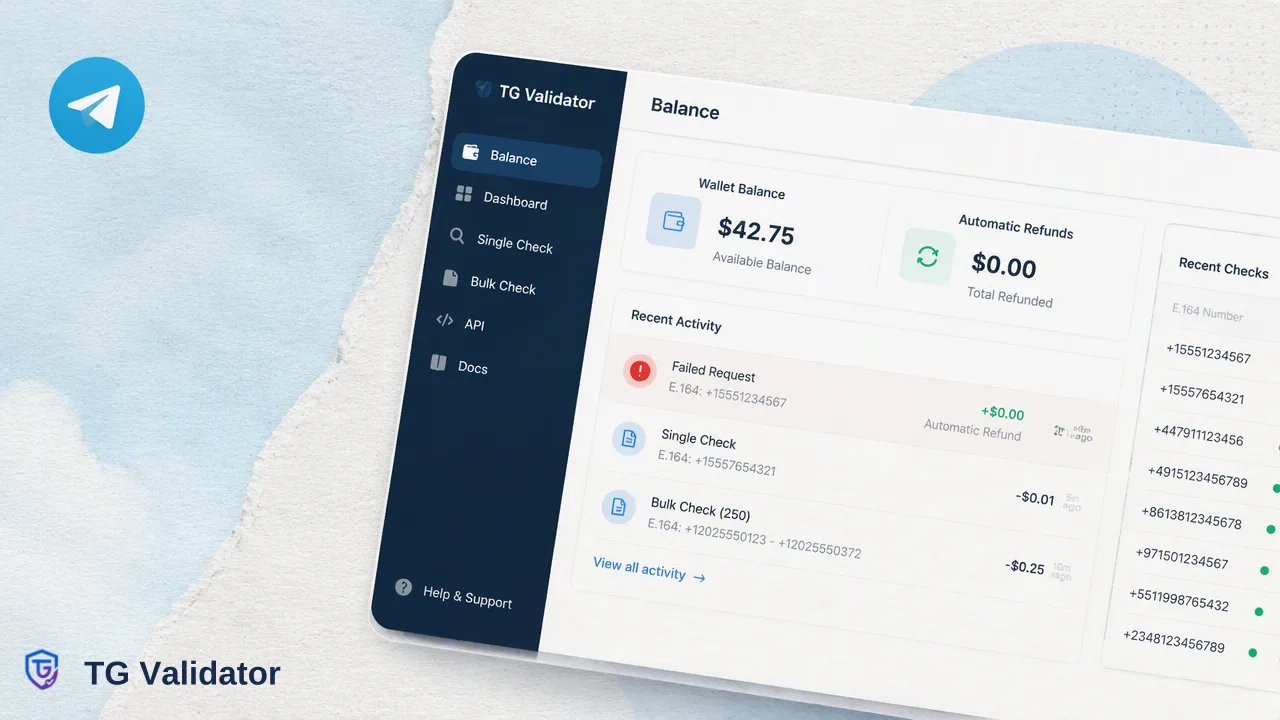
Learn how to integrate the TG Validator synchronous API for high-volume Telegram presence validation, manage concurrency limits, and handle transparent billing in B2B workflows.
Understanding the Synchronous API Architecture
TG Validator is built on a synchronous request-response architecture, meaning that one request returns one result within the same HTTP response cycle. This design supports immediate decision-making in B2B infrastructure, as developers do not need to implement complex polling mechanisms or webhook listeners to retrieve validation results.
Integration requires sending a POST request to the /api/v1/check endpoint. The request must include the X-API-Key header for authentication and a Content-Type: application/json header. The JSON body of the request is highly focused, requiring only two fields: service_type set to tg, and the identifier containing the target phone number. Because TG Validator is positioned as a single, focused Telegram-verification product rather than a multi-platform checker, the API workflow remains streamlined around this specific account-presence signal.
Formatting Inputs and Interpreting the Response Envelope
To ensure accurate processing, all phone numbers submitted as the identifier must strictly adhere to the E.164 format. This international numbering standard requires a leading plus sign followed by the country code and the subscriber number, eliminating ambiguity in cross-border validation requests.
For a completed Telegram check, the returned data contains only service_type, identifier, and registered; internal record, transaction, status, and billing fields are not returned.
For Telegram registration checks, the service_type=tg parameter ensures the API returns the registered field only. There are no avatar or business fields returned by this product. The data.registered field is the primary output, reporting the registration status of the submitted E.164 number at the time of the check.
Managing Operational Limits and Stability
Scaling high-volume validation requires strict adherence to the platform's operational boundaries. The TG Validator API enforces concurrency limits per account, and the API documentation is the authoritative source for the values in force. Infrastructure engineers must implement client-side throttling and connection pooling so their systems stay inside those thresholds during peak processing windows. If a system does exceed this boundary, the API will reject the request. However, concurrency-limit rejections are not charged and create no check result, protecting the user's balance from accidental spikes in traffic. To support robust error handling, the public API documentation lists specific error codes that developers should anticipate. These include errors for an unsupported service type, an invalid JSON body, an invalid phone number, a missing or invalid API key, insufficient balance, all concurrency slots occupied, a check that did not finish within its time budget, and validation service maintenance. By mapping these error codes to internal retry logic or alerting systems, teams can maintain a stable integration.
Billing Transparency and Dashboard Operations
Review balance and check history in the dashboard; the pricing page and API documentation define the current billing rules.
Applying the Account-Presence Signal in B2B Workflows
The registered field returned by the TG Validator API serves strictly as an account-presence signal at the time of the check. This signal helps teams review contact lists and supports audience segmentation workflows.
It is important to scope the interpretation of this data correctly within B2B infrastructure. A registered result indicates that the submitted E.164 phone number is associated with a Telegram account. By treating the validation result as one input alongside other checks, operations teams can safely inform their internal routing and review processes without overextending the meaning of the presence signal.
FAQ
What is the maximum throughput for the TG Validator API?
The API enforces a strict per-user concurrency limit, with the current value published in the API documentation. Infrastructure teams must design their client-side request handling to respect that boundary and to back off when a limit response arrives.
How are failed requests handled in the billing model?
Failed, timed-out, and undetermined checks do not retain the charge. See the pricing page for current billing details.
What format is required for phone number identifiers?
All phone numbers submitted to the API must be formatted according to the E.164 standard, which includes a leading plus sign followed by the country code and the subscriber number.
What does the registered field indicate?
The registered field provides an account-presence signal at the time of the check.