
Telegram Phone Number Checker on GitHub vs a Hosted API
Compare open-source Telegram phone number checker scripts from GitHub with a hosted REST API: setup, account risk, maintenance and data handling.
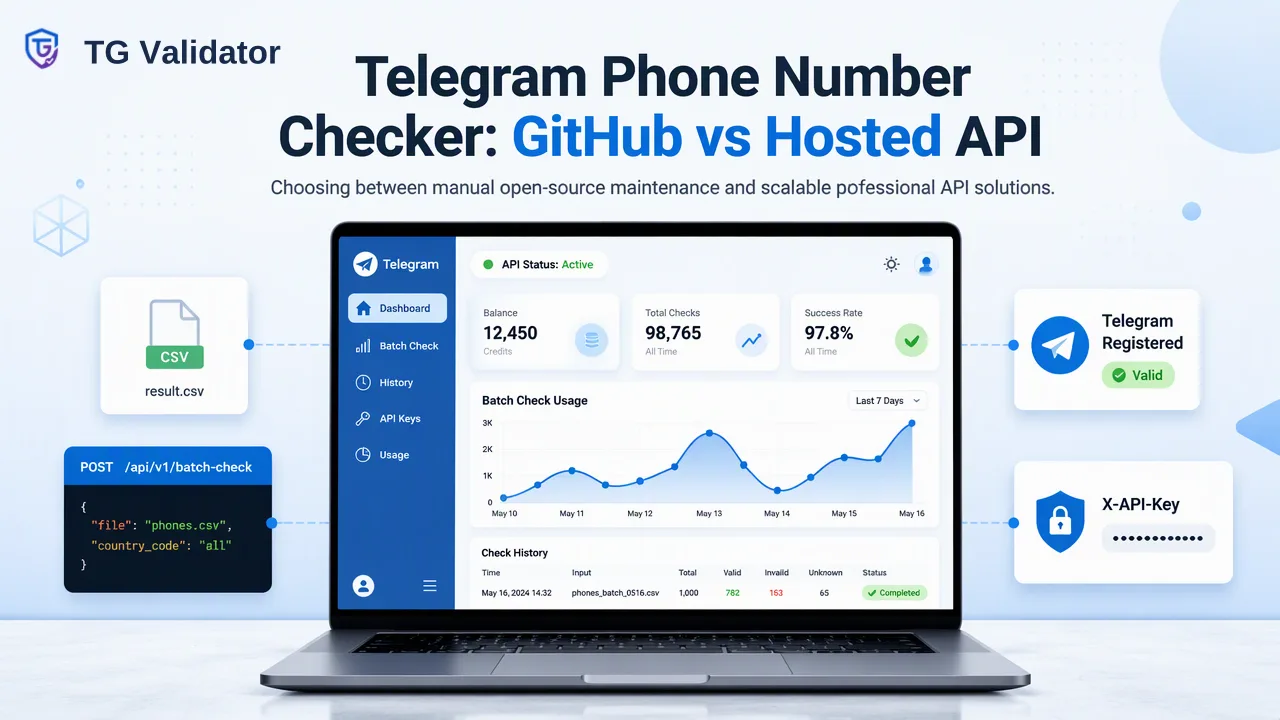
A neutral comparison of running an open-source Telegram phone number checker from GitHub and using a hosted registration check API and dashboard.
A Telegram phone number checker from GitHub, such as Bellingcat's open-source script, runs on your own Telegram user account and developer credentials, so it suits occasional research where someone can watch the account and maintain the code. A hosted API suits recurring business workflows, because the team calls a documented REST endpoint with an API key and never logs a personal Telegram account into automation. The choice comes down to volume, account risk, maintenance time and how results need to flow into other systems.
How Open-Source Telegram Phone Number Checkers Work
Most open-source checkers on GitHub follow the same pattern. The script logs into Telegram as a normal user through the client API, adds the target numbers as contacts, reads back which ones matched an account, and then removes them. Telegram's documented contacts.importContacts method describes this behaviour: it imports a contact list and returns the contacts that are already on Telegram. The method is available to user accounts only, not bots.
The best-known example is Bellingcat's telegram-phone-number-checker, an MIT-licensed Python tool. Its documentation lists what it needs:
- A Telegram account with an active phone number.
- An api_id and api_hash created at my.telegram.org.
- A list of numbers or usernames passed on the command line or interactively.
It returns usernames, names and account numbers where available, can download profile photos and writes results to a JSON file. Its documentation also warns that Telegram may block personal accounts used for automation and suggests using a fresh account.
What Running a GitHub Script Really Involves
The download is free, but the operating cost sits elsewhere.
Credentials and account setup
Telegram's guide to obtaining api_id explains that each phone number can be linked to only one api_id, and that accounts logging in through unofficial clients are placed under observation. The same page warns that using the API for flooding or spam leads to a permanent ban. A team therefore needs a dedicated number and account, and someone responsible for keeping that phone number current.
Account restrictions
Large contact imports from one account can trigger limits. When that happens, the script stops returning useful answers and the account may need recovery. Splitting work across many accounts to avoid this moves the project into territory Telegram's terms do not welcome.
Maintenance
Telegram updates its API layers and client libraries change. An unattended script can break after a dependency update, and someone has to read issues, pin versions and test again. For a research desk that checks a handful of numbers a month, this is manageable. For a CRM pipeline, it becomes an unplanned engineering task.
Data handling
Because the script imports numbers into a real account's contacts, the target data passes through that account. Telegram's FAQ notes that synced contacts are kept in sync until deleted, so cleanup steps need to be part of the process.
How a Hosted Telegram Check API Differs
A hosted registration check service removes the personal-account layer. With TG Validator, the integration authenticates with an API key in the X-API-Key header and sends one E.164 phone number to POST /api/v1/check with service type tg, or up to 100 numbers to POST /api/v1/batch-check. Results come back in the same response inside a documented code, msg and data envelope; a check that cannot be decided returns a non-zero business code instead of a completed result.
The same account also gives the team a web dashboard with a Single Check tab, a Batch Check tab for up to 500 pasted numbers, check history, usage reports and API key management. For large files, asynchronous bulk tasks accept TXT or CSV uploads and return one downloadable result.csv, with optional services that add username, approximate days since last activity or avatar-based estimates. An official MCP integration exposes single-number checking and balance tools to compatible AI clients using the same key, balance and limits.
The public API documentation describes per-user concurrency and timeout controls rather than a per-minute rate limit, so clients should queue requests and handle timeouts gracefully.
Side-by-Side Comparison
| Factor | Open-source script from GitHub | Hosted API and dashboard |
|---|---|---|
| Login | Your own Telegram user account plus developer credentials | API key; no personal Telegram login |
| Setup | Install Python, dependencies, credentials and a dedicated number | Create an account and key |
| Account risk | Automation can lead to limits on the account | No personal account involved |
| Maintenance | Your team tracks library and API changes | Provider maintains the service |
| Output | Whatever the script prints, often JSON | Documented response envelope; result.csv for bulk tasks |
| Undecided outcomes | Often a generic "no response" | Non-zero business code, separate from not registered |
| Non-developer access | Command line only | Web dashboard with history and usage reports |
| Cost | No licence fee; staff time and account risk | Per-check billing; see the pricing page |
Neither column is universally better. The script gives full control and transparency of the code; the hosted service trades that for predictable operations.
When Each Telegram Phone Number Checker Option Fits
A GitHub script tends to fit when:
- The work is occasional, investigative or academic, with small volumes.
- A technical person can supervise the account and update the code.
- The output is read by people rather than fed into production systems.
A hosted API tends to fit when:
- Checks run on a schedule or inside signup, CRM or support flows.
- Several team members, including non-developers, need to see results and history.
- The organisation prefers not to tie a business process to a personal Telegram account.
- Results need consistent states, including a clear undecided outcome, for downstream logic.
Some teams use both: a script for ad hoc research and a hosted service for the recurring pipeline. If that is the plan, keep the two result sets separate, because their definitions of a negative result differ.
Questions to Ask Before Choosing
- How many numbers per month, and how often? Recurring volume favours a service with documented behaviour.
- Who owns the Telegram account the script uses? If the answer is an employee's personal account, reconsider.
- What happens when a result is undecided? Make sure downstream systems can store that state.
- Where will results live? Plan field mapping, timestamps and retention before the first run.
- What is the purpose of the check? A registration result supports channel planning; it does not establish identity, consent or a likely reply.
Answering these questions first usually makes the choice obvious, and it keeps the workflow consistent with Telegram's API Terms of Service and the team's own data policies.
FAQ
Is Bellingcat's Telegram phone number checker free to use?
The tool is MIT-licensed and free to download. It requires a Telegram account with an active phone number and developer credentials from my.telegram.org, and its documentation warns that Telegram may block personal accounts used for automation.
Why do GitHub checkers need a Telegram account at all?
They use Telegram's client API as a normal user, typically importing numbers as contacts and reading which ones match an account. That method is available to user accounts only, so a logged-in account is required.
How can teams move from a script to a hosted API without losing history?
Export the script's past results with their check dates, keep them in a separate field or table, and start recording new hosted results alongside them. Re-check older records before reuse, since registration can change over time.
Does a hosted API return the same data as an open-source script?
Not necessarily. A hosted registration check returns a documented registration status, and optional bulk services add specific columns such as username or approximate activity. Scripts return whatever the code reads from the logged-in account, so outputs and definitions differ.
Learn More
Choose the product information that fits the next step in your workflow.