
Product guidance
What Is E.164? The International Phone Number Format Explained
Learn what E.164 phone number format is, how it is structured up to 15 digits, and why digital verification APIs require it for accurate normalization.
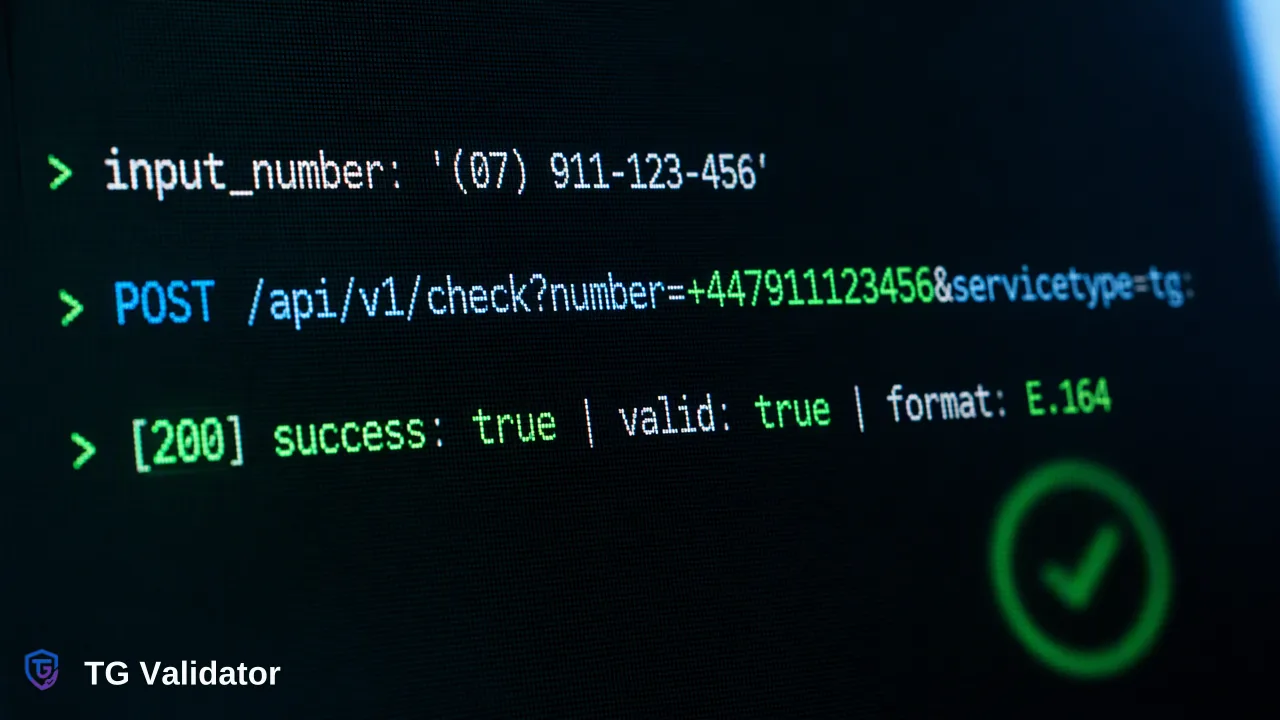
E.164 is the international telecommunications standard defining global phone number formatting. It combines a plus sign, country code, and national subscriber number within a maximum of 15 digits to ensure uniform processing across systems.
The E.164 phone number format is the international telecommunication standard that defines a uniform structure for globally routable telephone numbers. An E.164-compliant number begins with a leading plus sign (+), followed by an international country code and the national subscriber number, containing no spaces, hyphens, or formatting characters, and capped at a maximum of 15 digits. Digital systems, communications platforms, and verification APIs require E.164 normalization so phone identifiers can be parsed consistently across borders.
Defining the E.164 Standard
When evaluating what is E.164 phone number format, organizations look to the international telecommunications standard developed to establish global number interoperability. Traditional telephone systems evolved independently within individual nations, creating disparate regional conventions, trunk prefixes, and varying local digit lengths. Without a unifying structure, cross-border routing and digital record handling introduce operational ambiguities. The E.164 standard resolves these inconsistencies by establishing a single, globally recognized format for numbering plans. Under this specification, every telephone number represents an unambiguous address that can be resolved internationally without reliance on local dialing assumptions.
Structure and Components of an E.164 Number
An E.164 number follows a rigid, three-part architecture that eliminates localized dialing artifacts:
- Leading Plus Sign (+): Signifies that the string follows international numbering conventions and replaces local exit codes (such as
011in North America or00in Europe). * Country Code (CC): One to three digits assigned by the International Telecommunication Union (ITU) designating the destination country or shared geographic zone (for example,1for the North American Numbering Plan,44for the United Kingdom). * National Significant Number (NSN): Consists of the national destination code (area or network code) followed by the subscriber number, stripped of any domestic trunk prefixes like a leading zero. Under the E.164 standard, the total length across the country code and national subscriber number cannot exceed 15 digits. | Component | Description | Example (+14155552671) | | :--- | :--- | :--- | | Prefix | International notation symbol |+| | Country Code | ITU-designated country identifier |1(United States/Canada) | | National Significant Number | Area code and subscriber digits |4155552671| | Total Numeric Length | Maximum 15 digits permitted | 11 digits |
Local Dialing Formats vs. E.164 Normalization
In domestic telecommunications, numbers frequently rely on localized context. Users often write numbers using visual separators or regional trunk prefixes that fail outside that specific domestic network. For example, a user in the United Kingdom might write their mobile number as 07911 123456. In this context:
- The leading
0is a national trunk prefix intended only for domestic routing. * The space provides visual legibility for humans but introduces noise for database storage. * If dialed directly from abroad without modification, the call cannot complete. Converting this record into E.164 requires dropping the domestic trunk prefix0, adding the UK country code44, removing non-numeric characters, and prefixing the string with+, resulting in+447911123456. Database normalization ensures that internal platforms store identifiers consistently regardless of how users enter their information.
Why Systems Require E.164 Normalization
Data architecture and identity-verification workflows rely on deterministic formatting to process incoming records. When organizations ingest contact identifiers across multiple channels, unnormalized phone numbers create duplicate records, break query indexes, and generate routing rejections. Standardizing data to E.164 supports technical workflows in three primary ways:
- Deterministic Keying: Systems can use the normalized string as a clean, primary identifier or lookup key across internal databases. * Integration Consistency: Downstream communications and verification services require precise country codes to reach the intended network or platform. * Input Sanitization: Removing punctuation, localized trunk prefixes, and invalid characters reduces malformed payload errors during automated operations.
E.164 in Verification and Registration Checking
Beyond basic telecom routing, E.164 normalization is a prerequisite for modern verification systems. Verification services evaluate whether an identifier is reachable or registered on a target service, but they require the input to be parsed without regional ambiguity. For example, platforms checking platform-specific registration—such as TG Validator verifying Telegram registration status—require phone numbers to be submitted strictly in E.164 format. When submitting an identifier to POST /api/v1/check with service_type=tg, passing a standardized E.164 value ensures the platform can check the account-presence signal accurately in the synchronous response. Normalization ensures the service resolves the correct national code and subscriber line rather than rejecting the query due to unexpected formatting.
FAQ
What is the maximum length of an E.164 number?
An E.164 phone number can contain a maximum of 15 digits, excluding the leading plus sign. This character cap accommodates the international country code alongside the national destination code and individual subscriber number.
Does E.164 include spaces, parentheses, or hyphens?
No. The standard E.164 format strictly excludes visual formatting symbols such as spaces, hyphens, brackets, or parentheses. It consists exclusively of a leading plus symbol followed by continuous numeric digits.
Why is E.164 important for API integration?
APIs require unambiguous inputs to route, validate, or query records against specific networks or services. Normalizing inputs to E.164 ensures that differences in local dialing rules, leading zeros, or punctuation do not cause parsing failures or invalid routing across distributed systems.
Learn More
Choose the product information that fits the next step in your workflow.