
Product guidance
What Is an HLR Lookup? A Plain-English Definition
Learn what an HLR lookup is, what network data it reveals, and how it differs from messaging platform registration checks in technical workflows.
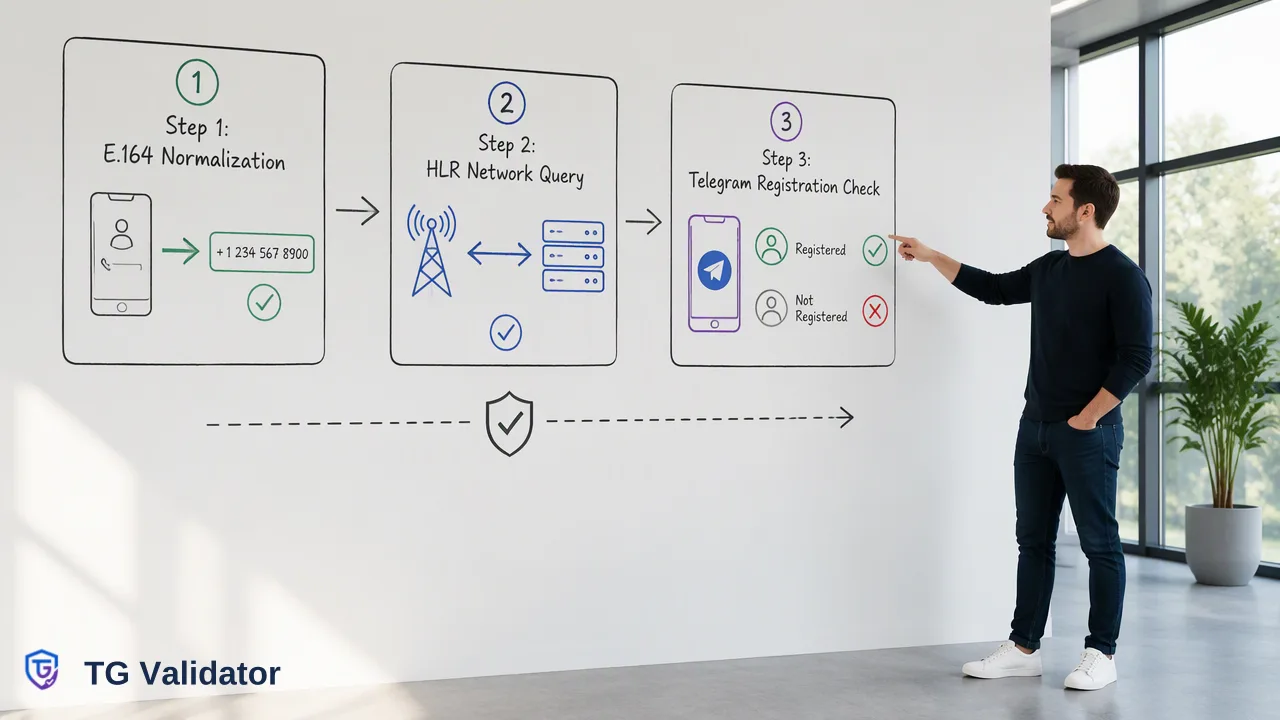
An HLR lookup queries mobile network carrier databases to verify phone number status, routing details, and network presence, distinct from platform registration checks.
An HLR lookup, or Home Location Register lookup, is a telecommunications query that retrieves the live operational status and network routing information of a mobile phone number directly from a cellular carrier database. Teams use an HLR lookup to determine whether a mobile subscription is currently provisioned, which network operator manages the line, and how signaling traffic should be routed across global mobile networks.
The Core Role of the Home Location Register
The Home Location Register (HLR) is an administrative and operational database maintained by mobile network operators. Every cellular subscriber authorized to connect to a public mobile network has an authoritative record stored within the operator's HLR. This database acts as the single source of truth for subscriber profiles within the core network architecture. When a cellular user makes a call, sends an SMS message, or moves between cell towers, telecom switching centers query the HLR. The register manages subscriber identity mappings, such as pairing the customer-facing phone number with internal network identifiers, and coordinates with Visitor Location Registers (VLR) to determine where signaling messages should be dispatched. An HLR lookup is an external signaling request—often executed over standard telecom signaling protocols—that requests the current status of that record without completing an actual telephone call.
What Information an HLR Query Provides
Executing an HLR query reveals network-level attributes tied directly to cellular connectivity and operator assignment. The data returned describes the state of the line inside telecom infrastructure rather than application usage. Typical technical attributes returned by an HLR lookup include:
- Subscription Status: Confirms whether the phone number is active and connected to a mobile network, suspended, or disconnected. - Mobile Country Code (MCC) and Mobile Network Code (MNC): Identifies the original country and the serving mobile network operator. - Ported Status: Shows whether the subscriber has transferred the phone number from the original issuing carrier to a different provider. - Roaming Status: Indicates whether the mobile device is currently registered on its home network or connected via a roaming partner. - Line Type Details: Distinguishes mobile subscriptions from landline or fixed-line configurations capable of standard cellular signaling. These carrier attributes help organizations optimize telecommunications routing, clean outdated mobile records, and reduce operational waste when sending direct carrier messages.
HLR Lookups vs. Platform Registration Checks
While HLR queries inspect telecom infrastructure, modern digital communication often occurs over closed messaging platforms rather than carrier networks. This distinction makes it essential to separate carrier-level routing checks from application-level registration checks. | Attribute | HLR Network Lookup | Platform Registration Check | | :--- | :--- | :--- | | Data Source | Mobile carrier core network (HLR/VLR) | Messaging platform service database | | Primary Metric | Network connectivity and operator routing | Account presence on the platform | | Query Type | Telecom signaling query | Synchronous service API check | | Context Provided | Carrier assignment, MCC/MNC, roaming | Platform registration status at check time | A registration result returned by a platform checker—such as TG Validator verifying Telegram—is an account-presence signal at check time. It clarifies whether a profile exists on that specific application layer. Carrier data confirms that a SIM card can receive cellular signals, while a platform check confirms that the identifier is registered with the third-party application.
How Teams Structure Verification Workflows
Engineering, operations, and support teams often design multi-stage verification workflows to evaluate incoming contact data. Selecting between an HLR lookup and a platform check depends on the planned communication channel. 1. Format Validation and Normalization: Teams first format raw inputs into standardized E.164 strings to establish universal routing syntax. 2. Carrier-Level Evaluation: When an organization plans to transmit cellular SMS notifications or voice calls, an HLR query verifies carrier connectivity, network presence, and whether the number has been disconnected from the mobile network. 3. Application Routing Evaluation: When a workflow prioritizes direct support or communications through dedicated apps, teams submit the normalized E.164 identifier to a platform checker like TG Validator. A synchronous REST API check confirms whether the number has an platform account-presence signals presence on Telegram, informing downstream routing choices. Applying the correct check at each operational stage ensures that systems query telecom networks when cellular connectivity is needed, and query application services when platform-specific reachability is the primary requirement.
FAQ
Does an HLR lookup confirm if a phone number is registered on Telegram?
No. An HLR lookup inspects cellular carrier records to check network provisioning and mobile routing. It does not communicate with application servers or verify whether a phone number has an associated Telegram account.
How does a platform registration check differ from a network lookup?
A network lookup queries carrier switching databases to confirm mobile network connectivity, whereas a platform registration check queries a specific service to provide an account-presence signal at check time.
What does a Telegram registration signal indicate?
A Telegram registration signal indicates whether an account presence exists on the platform for that submitted phone number at the exact moment of the check.
Learn More
Choose the product information that fits the next step in your workflow.